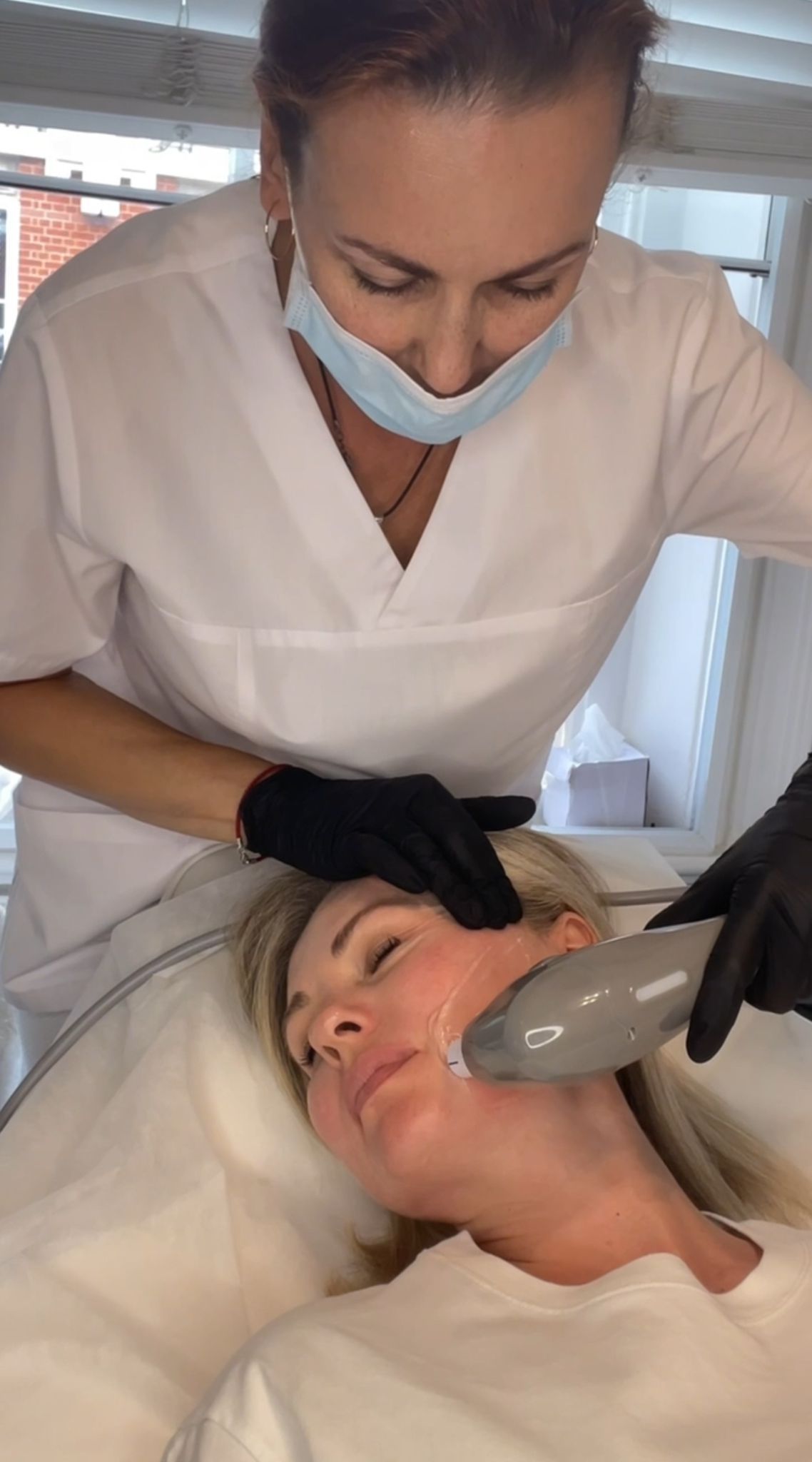
Lift, Tighten & Define — Without Surgery
Doctor-led clinic, following individually developed clinical protocols under the supervision of a GMC-registered doctor.
HIFU Face + Neck — £580
The problem may simply be deeper than any cream can reach.
If your face suddenly feels heavier and your jawline less defined, even though your weight hasn't changed — you're not imagining it. The change you see in the mirror may not be happening in the skin alone.
Tried treatments before, but your face still looks tired or heavy?
You may have tried serums, at-home devices, Botox, fillers or other treatments. Something may have helped for a while, only for the same heaviness, softer jawline or early jowls to return.
When the cause is deeper, treating the surface alone can only do so much.

HIFU Face + Neck — £580
Your treatment begins with a consultation and individual tissue assessment to determine whether HIFU is suitable for your face and what you can realistically expect.
HIFU is the tool. The clinical decision is what matters.
HIFU (High-Intensity Focused Ultrasound) delivers focused ultrasound energy at specific depths — from approximately 1.5mm closer to the surface down to 4.5mm in deeper tissue.
Its purpose is to create controlled stimulation at selected depths, encouraging your own collagen remodelling and supporting firmer, more defined tissue over time.
No incisions
Non-surgical treatment.
No added volume
Nothing is injected to change the shape of your face.
Personalised depths
Treatment depths are selected according to your individual assessment.
Two Similar Faces Can Need Completely Different Treatment
Two women can come to us with what looks like exactly the same problem — a softer jawline and early jowls. But underneath, their faces may be very different.
One may have heavier soft tissue and benefit from treatment at particular depths. Another may have less facial fat, where preserving volume becomes much more important. A third may have lost structural support in a different pattern altogether.
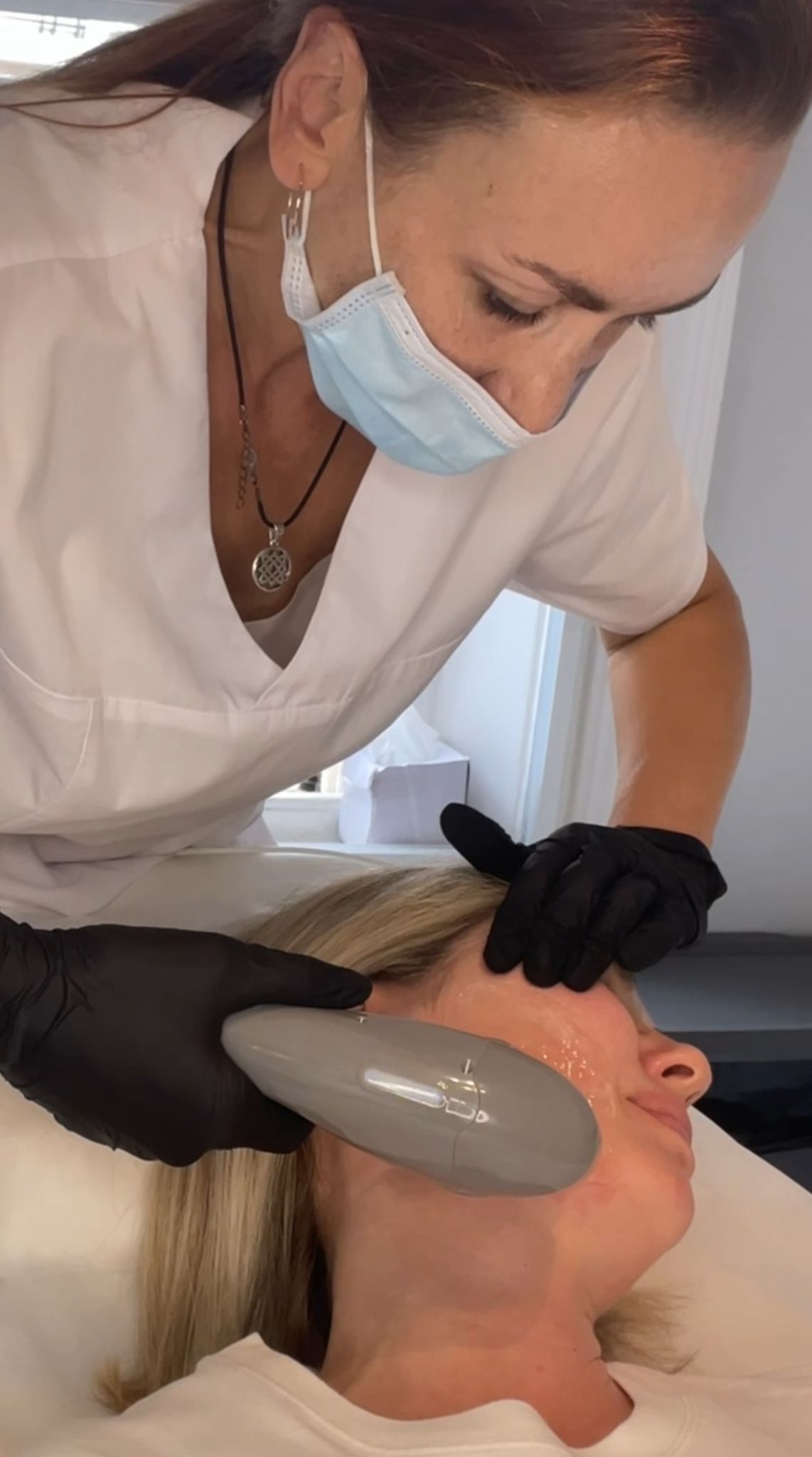
We Don't Start With HIFU. We Start With Your Face.
Before treatment, we assess the characteristics that can influence both your treatment plan and your result.
Condition, thickness and distribution of your tissue.
The amount and location of facial fat, helping preserve volume where it matters.
How and where facial support has changed.
Including perimenopause and menopause, which may influence tissue response.
Including fillers, threads, Botox and collagen stimulators.
A treatment planned around your face.
£580 current treatment price
Request a HIFU ConsultationYour treatment includes:
- Consultation before treatment
- Individual tissue assessment
- Personalised treatment areas
- Individually selected depths and energy
- Treatment within a doctor-led clinic
- Clinical protocols under the supervision of a GMC-registered doctor


Clear answers to common questions
About HIFU, suitability, treatment planning and results.
How does HIFU work and what depths are treated?
HIFU delivers focused ultrasound energy at specific depths beneath the skin — from approximately 1.5mm closer to the surface down to 4.5mm in deeper tissue.
This creates controlled stimulation at selected depths, encouraging your body's natural collagen remodelling process and supporting firmer, more defined tissue over time. At its deeper settings, HIFU can target a tissue depth that is also addressed during surgical lifting procedures. However, HIFU is a non-surgical treatment and should not be expected to reproduce the results of surgery.
The depth, treatment area and energy used are selected according to your individual facial assessment rather than applying the same protocol to every patient.
Why does the amount of HIFU treatment matter?
For a full-face treatment, we typically use in the region of 600–700 lines of energy, depending on your individual treatment plan.
In our clinical experience, shortened protocols can sometimes under-deliver, particularly when a comprehensive lifting treatment is indicated. For this reason, we don't reduce a clinically appropriate treatment simply to make the session faster.
However, more energy isn't automatically better. The amount, depth and location of treatment should be determined by your facial anatomy, tissue condition and individual needs.
The goal is not maximum HIFU. The goal is the right HIFU, in the right tissue, at the right depth.
What if I've had HIFU before and it didn't work?
A previous HIFU treatment that produced little or no noticeable improvement doesn't necessarily mean HIFU cannot work for you.
The same procedure can produce very different outcomes depending on facial anatomy, tissue condition, facial volume, treatment depth, energy and the protocol previously used.
Rather than simply repeating your previous treatment, we assess your face again and consider what may have limited the previous result. In some cases, a different treatment approach may be appropriate. And sometimes, after assessment, we may conclude that another HIFU treatment isn't what your face needs.
When will I see HIFU results?
HIFU isn't designed to produce an instant transformation. Results develop gradually as your tissue responds and collagen remodelling takes place.
Your results and how long they last can be influenced by factors including age, tissue condition, hormonal factors and previous treatment history. Individual results cannot be guaranteed.
Is HIFU right for everyone?
No — and we think that's important to say.
HIFU tends to be particularly suitable for people experiencing early to moderate tissue laxity, loss of jawline definition and early jowling, especially where the tissue still has a good capacity to respond.
However, significant excess skin, certain patterns of facial volume loss or anatomical changes that would normally require surgery cannot simply be corrected by applying more ultrasound energy. If we don't think HIFU is the right treatment for you, we'll tell you before you book it.
Why is every HIFU treatment different?
Because every face is different.
Before treatment, we consider factors including tissue condition and thickness, facial volume, the pattern of laxity, your anatomy, previous aesthetic treatments and how your tissue responds. These factors help determine where to treat, which depths to use, how much energy is appropriate and where treatment may need to be avoided.
Your treatment plan may also be adjusted during the procedure according to how your tissue responds. You aren't buying a standard number of ultrasound lines. You're receiving a treatment plan built around your face.
What Our Patients Say
Google reviews



 Trustindex verifies that the original source of the review is Google.
  Trustindex verifies that the original source of the review is Google.
  Trustindex verifies that the original source of the review is Google.
  Trustindex verifies that the original source of the review is Google.
  Trustindex verifies that the original source of the review is Google.
  Trustindex verifies that the original source of the review is Google.
  Trustindex verifies that the original source of the review is Google.
  Trustindex verifies that the original source of the review is Google.
  Trustindex verifies that the original source of the review is Google.